Copper peptides
AHK-Cu and the isolated follicle
The most revealing letter in this file is the A at the start of AHK-Cu.
AHK-Cu in human follicles
I nearly gave GHK-Cu credit for this experiment. Then the opening letter of the molecule’s name stopped me. The paper on human hair growth in vitro tested AHK-Cu, the alanyl analogue of GHK-Cu. It offers a close comparison for the copper-peptide family, with its own identity intact.
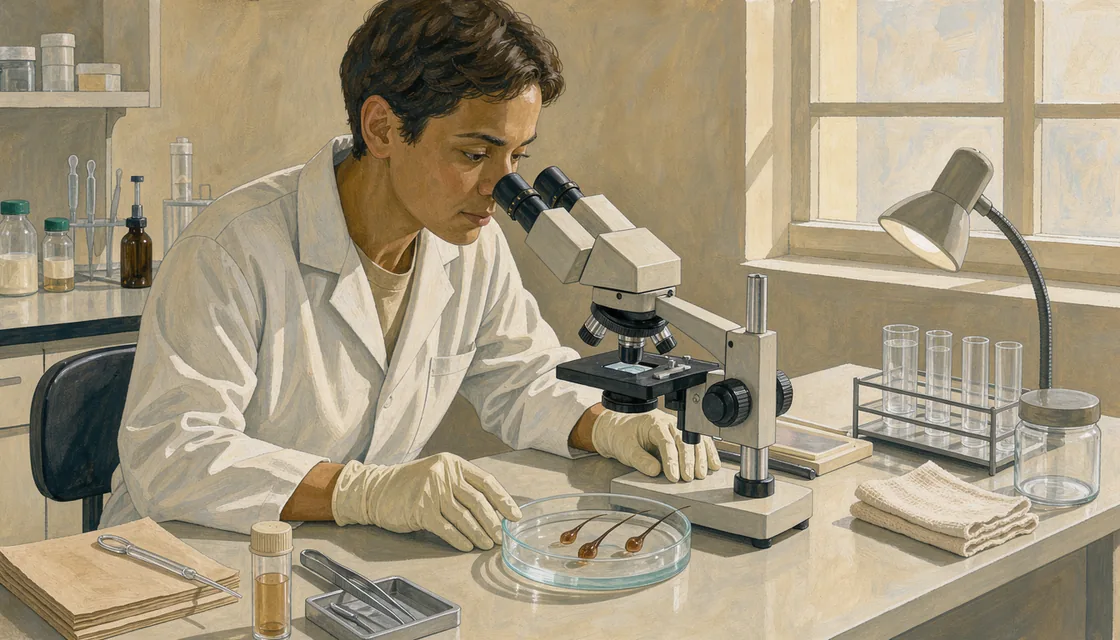
The researchers reported elongation of human hair follicles outside the body, alongside proliferation of cultured human dermal papilla cells. “Ex vivo” is the compact term for that tissue-outside-the-body setting. The human origin makes this an interesting hair experiment; the setting confines its conclusions to isolated tissue and cultured cells.
A longer isolated follicle is a tangible observation. I would happily put more such work on the research shelf. A claim about a living person’s hair still has further ground to cover, including whether the same preparation produces a measurable change on a scalp.
Cell survival
The same experiment also reported reduced apoptosis, the process of programmed cell death, in the AHK-Cu cell work. The reported changes included a higher Bcl-2/Bax ratio and lower cleaved caspase-3 and PARP. These are cell-level observations accompanying the follicle result.
The pairing of elongation and survival earns my attention. It gives the experiment a biological question worth pursuing: can this sort of support persist in the setting where hair loss actually happens? That question remains a research proposal here. The isolated tissue cannot supply its own clinical follow-up.
GHK-Cu and collagen synthesis
There is a separate, older reason to take GHK-Cu seriously. In human fibroblast cultures, GHK-Cu stimulated collagen synthesis without changing the number of cells. That is a specific tissue-related effect, rather than simply a dish containing more cells.
The distinction between the experiments is satisfying. One concerns AHK-Cu, follicles and dermal papilla cells; the other concerns GHK-Cu and collagen synthesis in fibroblasts. I rate both as useful leads, and the follicle experiment as the more direct lead for a hair question. Combining their reputations would blur the very feature that makes each worth reading.
For an outcome measured in people, the next file is the GHK combination hair-count trial. It introduces another companion molecule, so the attribution question follows us there.