Human hair-count record
The GHK combination hair-count trial
Actual hair counts give this experiment a prominent place in the cabinet; the combination deserves equal prominence.
The preparation and the participants
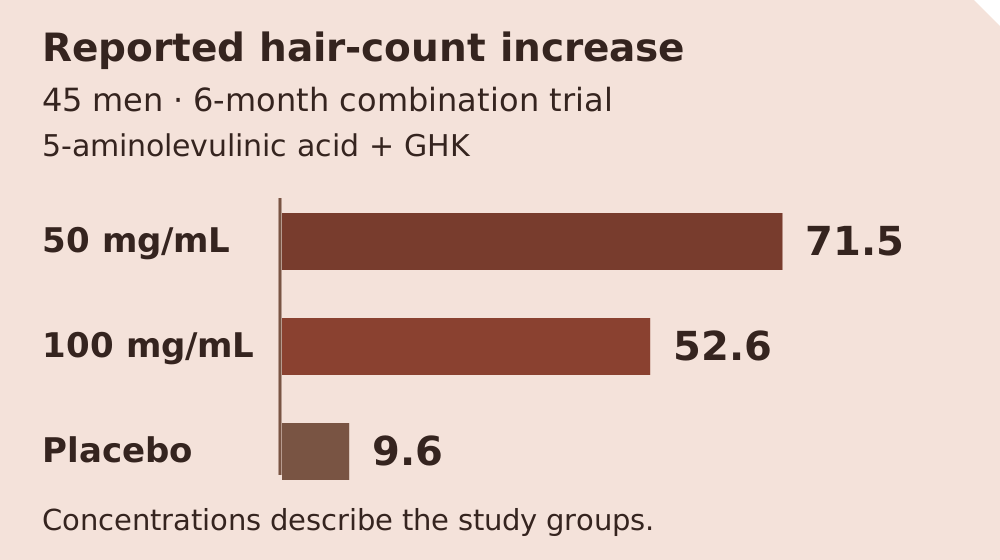
Here is the file with people and a hair-count outcome. The trial tested a complex of 5-aminolevulinic acid and glycyl-histidyl-lysine peptide, or GHK, in 45 men with androgenetic alopecia. The participants’ hair-loss grades were Norwood-Hamilton II–V, and the observation period was 6 months.
The preparation matters from the outset. The topical study groups used concentrations of 50 mg/mL and 100 mg/mL, alongside a placebo group. The compound under examination was the combination throughout.
Counting hair puts this trial ahead of a pathway on its own. It also sets a narrower question than “does GHK-Cu restore hair?” because its preparation includes a companion molecule and is named as a GHK complex.
Reported hair-count changes
The reported increase in hair count was 71.5 in the 50 mg/mL group, 52.6 in the 100 mg/mL group and 9.6 with placebo. The study reported significant gains versus placebo.
The larger change occurred in the lower-concentration study group. That ordering resists a casual “more is better” story. It describes these groups in this experiment; it cannot pick a preparation for someone outside it.
Attributing the hair-count change
The comparison was the 5-aminolevulinic acid and GHK complex against placebo. I leave the credit for the observed change with the combination as a whole. The AHK-Cu follicle experiment concerns a different molecule and an isolated-tissue setting; it cannot stand in for an ingredient-isolating arm of this trial.
My preference for this result is quite specific: it moves the conversation to a measured hair outcome in people. A trial separating the components while preserving a comparable hair-count outcome would settle the credit question more directly.
Reported tolerability
The paper reported no adverse events in any group. That is an encouraging observation within the participants and period described. A larger, longer controlled study would give the tolerability finding more weight.
There is another preparation question before any hair result can travel far: how does the material get through skin? That file deals with the delivery experiments on their own terms.