Topical delivery
GHK-Cu delivery through skin
The destination of the copper is an interesting measurement in its own right.
The skin-layer experiment
The glamorous part of a peptide story is usually its biological activity. I am increasingly interested in the less glamorous part: whether the preparation arrives where its proposed activity would matter.
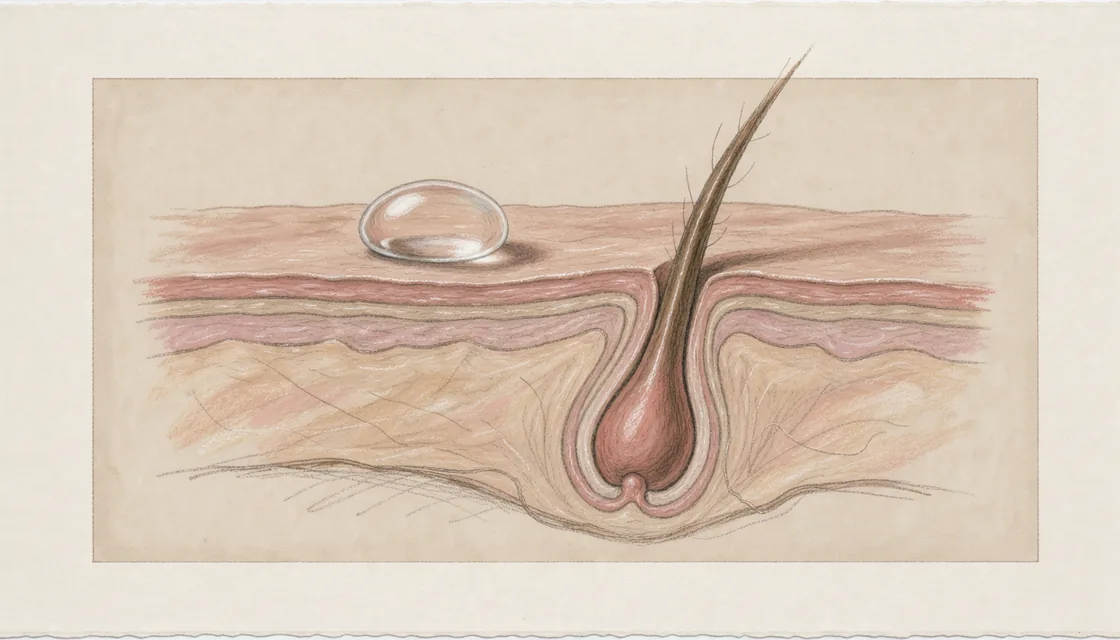
A human-skin penetration experiment measured copper applied as a GHK-Cu tripeptide across skin layers. This was work on human skin outside the body. Over the experiment’s 48-hour observation, the investigators measured copper permeation and copper retained in the skin as a dermal depot.
The copper depot makes this a tangible result: some of the applied copper passed through, some remained in the tissue. The measured material was copper, and the outcome was transport through skin layers. Hair count was a different question.
The formulation problem
A review of topically applied GHK describes poor stratum-corneum permeability as a central delivery challenge. The stratum corneum is the skin’s outer barrier. The review examines chemical modification of GHK and microneedle pretreatment among the approaches studied to improve passage.
Those interventions make the preparation more interesting, and the interpretation more demanding. A modified peptide and a changed delivery procedure each introduce a feature that deserves its own evaluation. An ingredient name alone leaves me with too little information to carry a finding from one preparation to another.
The review’s subject is GHK as an anti-wrinkle peptide and the problems of topical delivery. That gives it a useful place beside the skin-layer experiment. It does not supply a hair-count result for every approach it describes.
Skin outcomes and hair outcomes
The GHK-Cu collagen experiment in human fibroblast cultures gives a reason to investigate tissue effects. The GHK combination trial in men asks a hair-count question with a particular preparation. Putting the findings beside each other helps me see the work still needed between an active molecule, a delivery system and a hair outcome.
The priority for follow-up is the exact preparation, evaluated for hair-count change and tolerability under controlled conditions.
Safety questions for follow-up
The skin-layer measurements make distribution worth investigating, while the formulation review shows why changing delivery can change the experiment. I want irritation observations and longer follow-up attached to the same preparation being evaluated for hair.
A follow-up with the same preparation could put those observations beside the hair counts. The reading list gathers the experiments that give the questions their shape.